
See
Artist Ann Hamilton said, “In every work of art something appears that did not previously exist, and so, by default, you work from what you know to what you don’t know.”
Our 2026 commissions re-imagine the major festivals of the liturgical calendar. Artists and sculptures working in wood, glass, fiber, paint, and textile explore the strangeness and mystery of these millennia-old liturgical rhythms, and the unique light they cast on present-day questions of flourishing, peace, and interdependence. By making the familiar unfamiliar—working from the known to the unknown—tradition is enlivened and new possibilities for engagement and understanding begin to emerge.
Precision
Viola Bordon
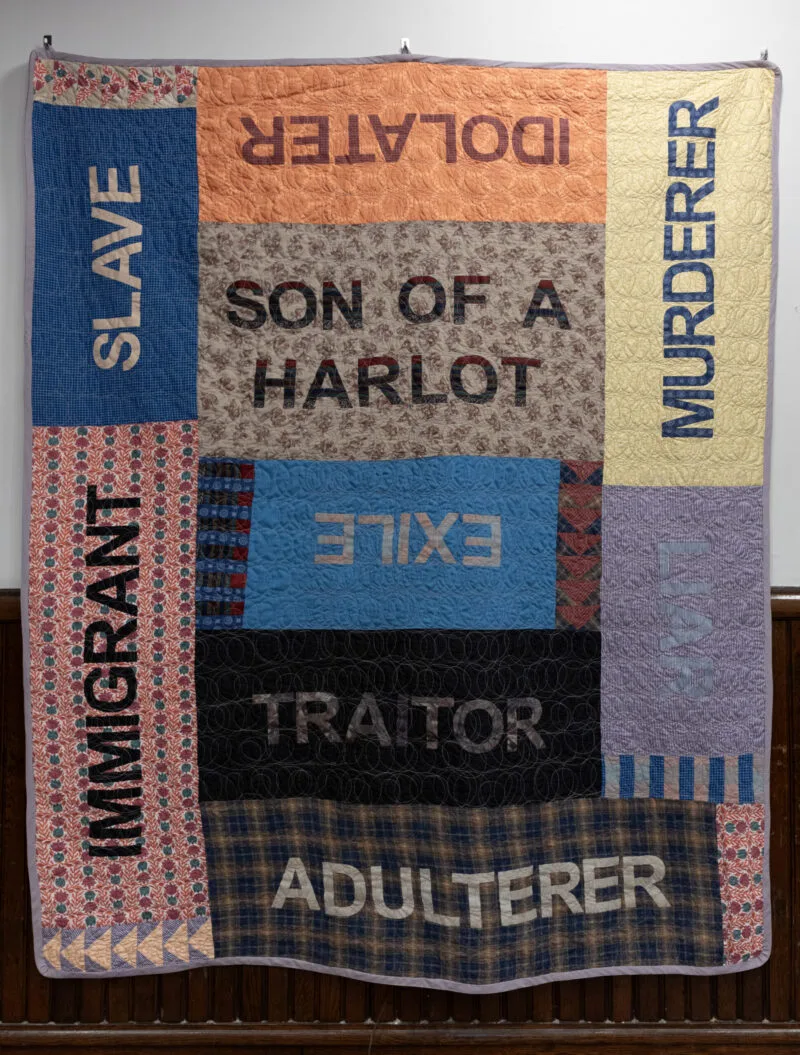
Flesh of a Door
Dot Jackson
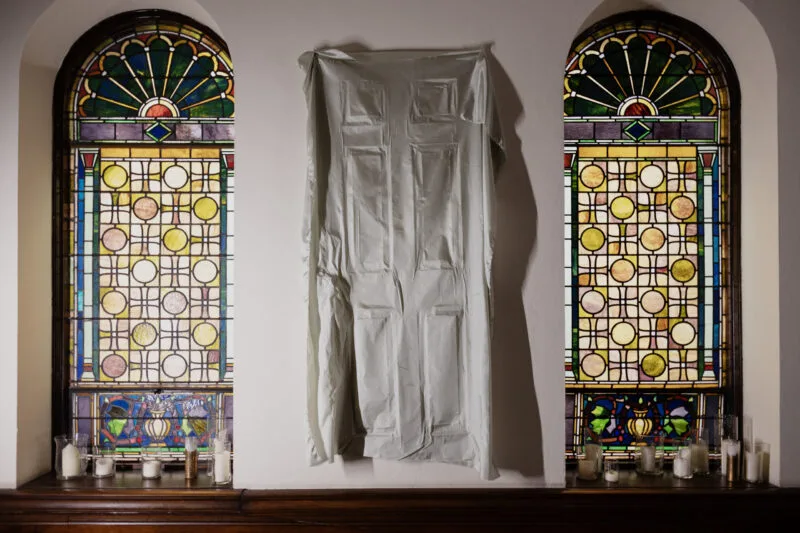
satin, rabbit skin glue, 2025
In Flesh of a Door, Jackson creates a series of satin casts of a door to study its intimacies and impressions. Through this work, she remains curious about the symbolic nature that entrances, departures, boundaries, and portals hold, all while considering their spiritual, physical and incarnational significance.
Speculative Atlas
Laura Sallade
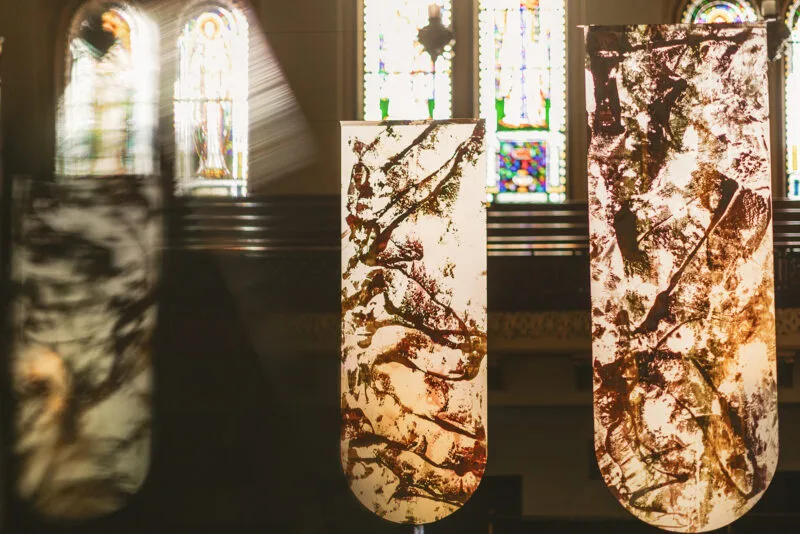
Expanding on my repertoire of architectural materials and chemical processes, I have been thinking through the overt and obscured ways materials shape our perception. A central interest in this work has been glass: its intrinsic relationship to light and its presence in almost every aspect of daily life. As a craft and a technology, this material has shaped concepts of transparency, both materially and metaphorically. It also has a lineage, a thread that when pulled can reveal insights into the various layers within the complex system of material ecology. I am interested in the potential glass has to map some of this complexity and to re-center the mystery and paradox it has helped marginalize throughout history.
Outpouring of the Spirit
Caleb Stoltzfus
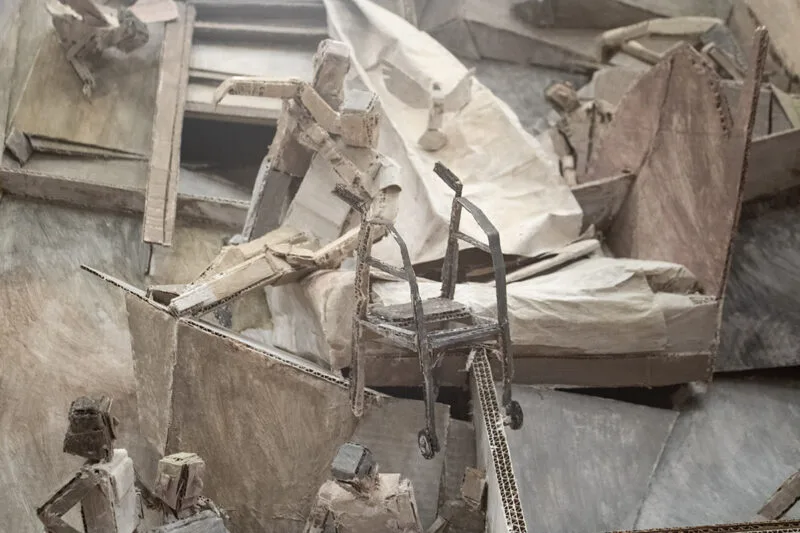
At the top of the 8-panel relief sculpture, a figure presses his ear to the ground, listening for the movement of the Spirit. Below, scenes of work and study demonstrate vocational participation in the work of the Spirit. Above these figures are scenes of life together, centered on a memory of his father helping his grandfather into bed.
While this piece references Baroque compositional dynamism, it is constructed entirely from cardboard. The familiar, non-archival material contrasts with the extravagance of the style it references, suggesting that the Spirit pours equally into both the ordinary and the extraordinary.
MOYA SEM’YA (MY FAMILY)
Benjamin Stamper, Joshua Stamper
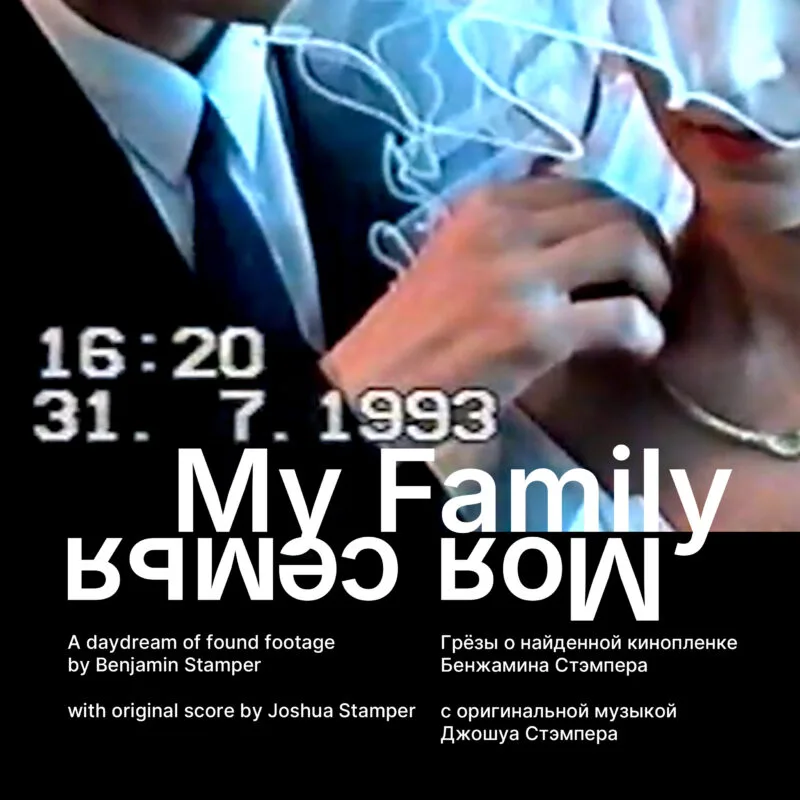
MOYA SEM’YA (MY FAMILY) is a hypnotic portrayal of one Muscovite family through a vast archive of home movies that spans several decades. Exploring themes of impermanence, sacrament and language, MOYA SEM’YA is a mosaic of time-stamped memories that reveals worlds within worlds.
Directed by Benjamin Stamper.
Original score by Joshua Stamper.
Runtime approx. 30 min.
Premiering September 25, 2026 at Presence and Mystery: a Re:Echo Symposium on Art and Flourishing, Philadelphia, PA.